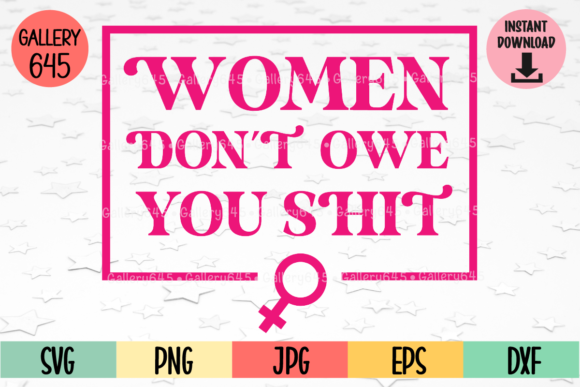
Women Don't Owe You Shit: A Designer's Review
As a professional designer who spends countless hours curating assets for client projects and my own craft business, I approach every new graphic with a critical eye. When I first opened the file for Women Don't Owe You Shit, my initial reaction was one of immediate recognition. This isn't just another trendy phrase; it is a bold statement that demands attention. In the world of Illustrations and Graphics, this design stands out because it cuts through the noise. However, before I commit to stitching this onto a sweatshirt or selling it as an embroidered patch, I need to evaluate how it translates from a digital screen to a tangible finished product.
The Visual Impact and Mood
The mood created by Women Don't Owe You Shit is unapologetic, confident, and slightly rebellious. Visually, the layout is straightforward, which is often a strength in embroidery. Complex illustrations can get lost when converted into a machine embroidery design, but text-based graphics like this usually maintain their integrity if the font choice is right. The shape of the lettering suggests a strong presence, making it ideal for custom apparel where the message needs to be read from a distance.
When considering this as a tote bag design, the visual weight feels appropriate. A canvas tote offers a flat, stable surface that allows the text to breathe without distortion. The theme resonates deeply with the target audience for feminist merchandise, suggesting high potential for Etsy seller success. However, the visual personality relies heavily on clarity. If the stitch density is too high or the lines are too thin, the impact will be diluted. As a reviewer, I look for designs that retain their punch after the needle hits the fabric, and this graphic has the potential to do exactly that.
Real-World Application: The Sweatshirt Scenario
Let's imagine a real-life scenario. I am preparing a limited run of heavyweight crewneck sweatshirts for a boutique shop owner. She wants something that speaks to her core demographic of young, empowered women. I load the digital embroidery file into my software to test how Women Don't Owe You Shit performs on a curved chest area.
On a sweatshirt embroidery project, the texture of the fleece can sometimes interfere with fine details. Since this design is primarily typographic, the risk of detail loss is lower than with intricate floral patterns, but the thickness of the letters matters. I would likely opt for a fill stitch rather than a running stitch to ensure the text sits firmly against the thick cotton blend. The contrast is key here; using a vibrant red or electric blue thread against a charcoal grey background would maximize visibility. This kind of personalized gift or small shop product needs to pop off the shelf, and the boldness of the phrase ensures it does.
Furthermore, thinking about customer trust, a well-executed version of this design signals quality. If the stitching is clean and the lettering is crisp, it elevates the perceived value of the garment. Conversely, if the thread colors bleed or the letters merge due to poor digitizing, it reflects poorly on the brand. This is why I always advise testing the design on scrap fabric first. It is a small step that prevents costly mistakes on expensive materials.
Navigating Fabric Challenges and Hoop Sizes
While this design is versatile, there are specific situations where caution is required. Women Don't Owe You Shit is a long phrase, which immediately dictates the minimum hoop size needed. Attempting to fit this entire line into a 4x4 inch hoop would force the text to be uncomfortably small, leading to legibility issues. For caps or baby clothes, the design might need to be shortened or split across multiple lines, which could alter the intended flow of the message.
Texture also plays a significant role. On a textured fabric like a linen apron or a knit baby blanket, the needle must work harder to penetrate the fibers. Here, the use of a proper stabilizer becomes non-negotiable. Without it, the fabric may pucker around the dense text, ruining the professional look of the handmade product. Additionally, on dark fabrics, a bright white underlay is essential to make the text stand out. If you are working with stretchy fabric, such as jersey material for t-shirts, the tension settings on your machine must be adjusted to prevent the stitches from pulling the fabric out of shape.
Another consideration is the frequency of washing. Items like kitchen towels or holiday gifts that will see heavy use need durable stitching. A satins stitch edge around the letters can add durability, but if the design relies solely on fill, the edges might fray over time. Checking the stitch density in the preview mode of your software helps identify areas that might be too sparse or too tight before you ever thread your machine.
Commercial Viability and Brand Consistency
For creative entrepreneurs and craft business owners, the commercial viability of Women Don't Owe You Shit is high. It fits perfectly into categories like holiday embroidery (specifically for New Year's resolutions or Women's History Month) and general empowerment themes. However, consistency is vital. If you are building a brand around bold, feminist messaging, this design aligns well. But if your shop specializes in delicate, vintage aesthetics, this graphic might feel jarring.
Before listing this as a small shop product, I recommend creating printable mockups to visualize the final result. Seeing the design on a black and white background versus a colorful one can reveal contrast issues you might miss on screen. Also, always confirm the licensing terms. While the product description mentions files for Cricut and Silhouette, which implies cutting, the prompt specifies we are evaluating it for embroidery. Ensure the license explicitly permits commercial embroidery and the sale of finished items. Using a design without the correct rights can lead to legal headaches that no Etsy seller wants.
Final Thoughts for the Maker
In conclusion, Women Don't Owe You Shit is a powerful asset for any designer looking to create impactful custom apparel or personalized products. Its strength lies in its message and simplicity, but its success depends entirely on execution. By paying attention to hoop size, fabric choice, and stabilizer usage, you can turn this digital file into a high-quality physical item.
Whether you are making a single embroidered patch for a friend or producing a batch of holiday gifts for your store, take the time to test the design. Check the thread colors for maximum contrast, review the stitch density for clarity, and ensure the final presentation matches your brand's standards. With careful planning, this design can become a staple in your portfolio, offering both style and substance to your customers.